

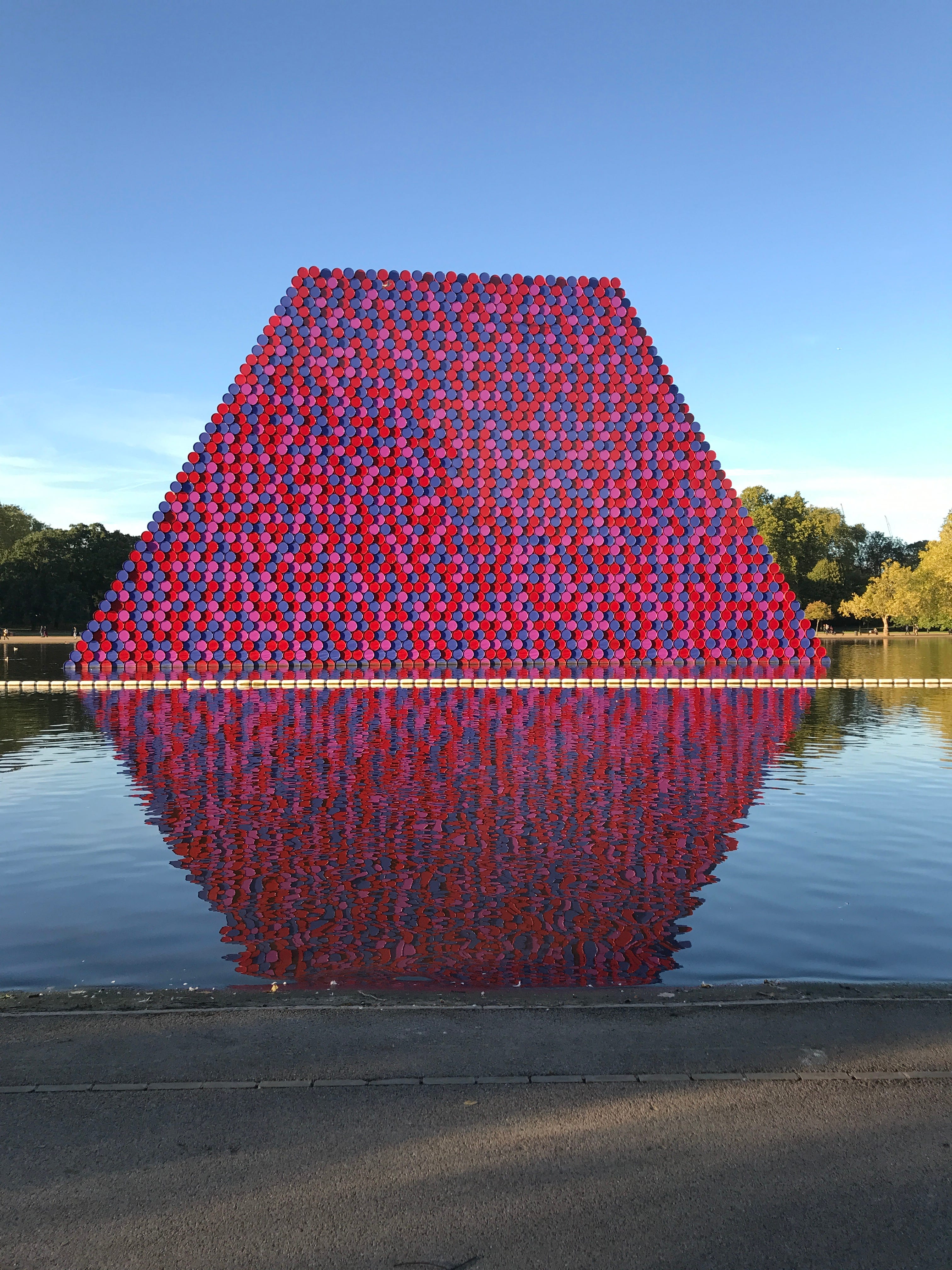
About eight years ago, I came across what seemed like an engineering marvel: dozens of brightly colored barrels stacked into a towering prism floating on the Serpentine, a lake in London.
To my surprise, it wasn’t an engineering project at all, but rather a temporary installation by the artist Christo. The piece, titled The London Mastaba, blew me away.
What would it be like, I wondered, to have fewer constraints on your creativity? To have a wild idea and be able to bring it to life with a bit of effort, ingenuity, and persistence?
Recently, as I’ve been using the tools we’re building at CodeYam, particularly our not-yet-widely-released v2 Editor, alongside AI tools like Claude Code, I’ve found myself having more ideas — and more creative ones.
I suspect part of the reason is that there’s less friction between imagination and exploration. I’m increasingly confident that, with enough curiosity and persistence, I can bring an idea to life and learn from it. I may ultimately discard it, but not before I’ve had the chance to see what it could become.
I’ve found myself repeatedly building small tools, prototypes, and experiments that I simply wouldn’t have attempted a few years ago because they didn’t seem worth the time and energy required to get them off the ground.
The websites and applications I build are rarely perfect or production-ready right away. But for the first time, building software that closely matches the idea in my head feels dramatically more accessible.
While my background is not engineering, I’ve spent nearly a decade building and working on technology products. I’ve developed confidence in my ability to take an idea and go from specification to prototype, MVP, production, and even to meaningful scale.
At CodeYam, and as a result of my own research and explorations with AI tools, I’ve realized we’re at an extraordinary point in the history of software development. More than ever before, creativity, judgment, and persistence are becoming the primary constraints. The bottleneck is not technical knowledge, nor access to an entire team of specialists.
This, of course, is not universally true and has caveats and exceptions. For instance, being able to debug issues, even using AI, requires patience and benefits from insight and experience. It’s not realistic to expect a non-technical founder to suddenly become a full-stack software expert.
But more than ever before, that non-technical founder can go significantly further in validating and bringing ideas to life before hiring a team or outsourcing work.
Over five years ago, one of the early ideas my cofounder and CTO, Jared, and I explored was how to empower more people to build higher-quality software more efficiently.
At the time, there was a tradeoff. You could build custom software if you had technical skills, or use low-code and no-code tools that made software more accessible at the cost of flexibility. The problem was that you were constrained by the available LEGO bricks. Even if there were thousands of them, you were still building within someone else’s system.
AI changes this equation, though it doesn’t eliminate it entirely. On one end, you have chat-based “vibe coder” tools, usually accessed through web or desktop interfaces. On the other, you have the raw speed and power of AI agents running directly in your terminal through Command Line Interface (CLI) tools.
One approach prioritizes accessibility, while the other prioritizes capability. But what if that tradeoff began to disappear?
I believe we’re approaching a convergence point where the best builders, technical and non-technical alike, will increasingly rely on the same underlying tools. The difference won’t be access to technology. It’ll be creativity, taste, judgment, and persistence.
Anecdotally, I’ve watched many of my most determined friends, developers and non-developers alike, follow a remarkably similar path.
I’ve watched the same progression happen over and over:
ChatGPT →
Claude Desktop →
Cursor or VS Code →
AI agents running directly in the terminal.
Each step in this progression unlocks more capability, while also introducing more complexity.
The terminal remains needlessly intimidating for many people. The folks I’ve seen succeed tend to share a few traits: curiosity, determination, and a willingness to experiment despite not fully understanding what’s happening yet. They aren’t necessarily the most technical people. They’re often just the most curious and willing to learn and experiment.
In getting early feedback on CodeYam, I helped a number of non-technical users set up the Claude Code CLI in their native terminal. The experience surprised me.
Many of these folks were genuinely nervous because the terminal felt foreign and daunting. They were worried they’d break something, delete something important, or get stuck. Yet every one of them eventually got through it.
Watching someone realize they could build software themselves, even imperfectly, was thrilling. In some cases, they immediately started brainstorming what else they could build.
Beyond that, there’s often less to be afraid of once you’re up and running because if something goes wrong, you can simply ask the AI about it. AI does not always give you the right answer right away, so getting calibrated on what answers are legitimate and what are more likely to be bullshit goes a long way.
One thing I’ve learned from my cofounder Jared Cosulich is that the quality of the question often determines the quality of the answer, whether you’re working with an AI agent or another human being. Words like “debug,” “analyze,” “find the root cause,” and “avoid bandaids” matter more than you might realize.
There’s still a tremendous amount to improve.
Experienced builders should be able to move faster. New builders shouldn’t have to endure seven onboarding circles of hell just to get started. When things go wrong, it should be easier to recover.
And once you’ve built something, maintaining and evolving it should be as easy as creating it in the first place. We need new ways for humans and agents alike to navigate growing codebases and increasingly complex products.
These are the problems Jared and I have spent years thinking about at CodeYam. We’re only beginning to share our v2 Editor with people outside our immediate team, but the early results have been encouraging.
As part of that effort, we’re planning to work closely with a small number of individuals and companies building something new — whether that’s a website, an application, or an internal tool.
If you have an idea that’s been sitting in a notebook, buried in a backlog, or trapped in your head, we’d love to hear about it.
Eight years ago, standing beside The London Mastaba, I found myself wondering what it would be like to have fewer constraints on creativity.
Today, for software, that future feels much closer than I imagined. Not because all the challenges have disappeared, but because many of the ones that once required a team of specialists, months of work, or a significant budget can now be overcome with curiosity, persistence, and the right tools.
It’s still not easy, and it’s absolutely possible to make serious mistakes, especially if you don’t know what you’re doing. But a determined person can go further and faster in bringing an idea to life than ever before.
Don’t let technology, uncertainty, or abstract fear of risks stop you from building something you care about or tinkering with an idea. There has never been a better time to turn curiosity into something real.
If you need help, come find me.
I get "Inventing on Principle"[1] vibes here! I've thought a lot about AI and creative work and I don't have any clear answers but I think we're thinking in the same tribe around this. Fun!
[1] https://www.youtube.com/watch?v=PUv66718DII