

Our work on CodeYam has been atypical for many startup founders in that we’ve spent the past couple of years deep in technical research and development. While I’ve done a lot to stay connected with our target audience, people building software, both experienced developers and less technical “vibe coders” or founders who want to build but haven’t yet, especially with AI, we haven’t often been able to ship something they can actually try and give feedback on.
Exploring the ideal AI-native development experience has required deep, ongoing R&D. We’re working on the frontier of several technologies and pushing them to do things they’ve only recently become capable of, like generating software simulations.
Recently, we decided to take a bite-sized first step toward our vision for the ideal development experience in this new AI era. We turned an internal tool we built to manage Claude Code’s memories into a small product others could try.
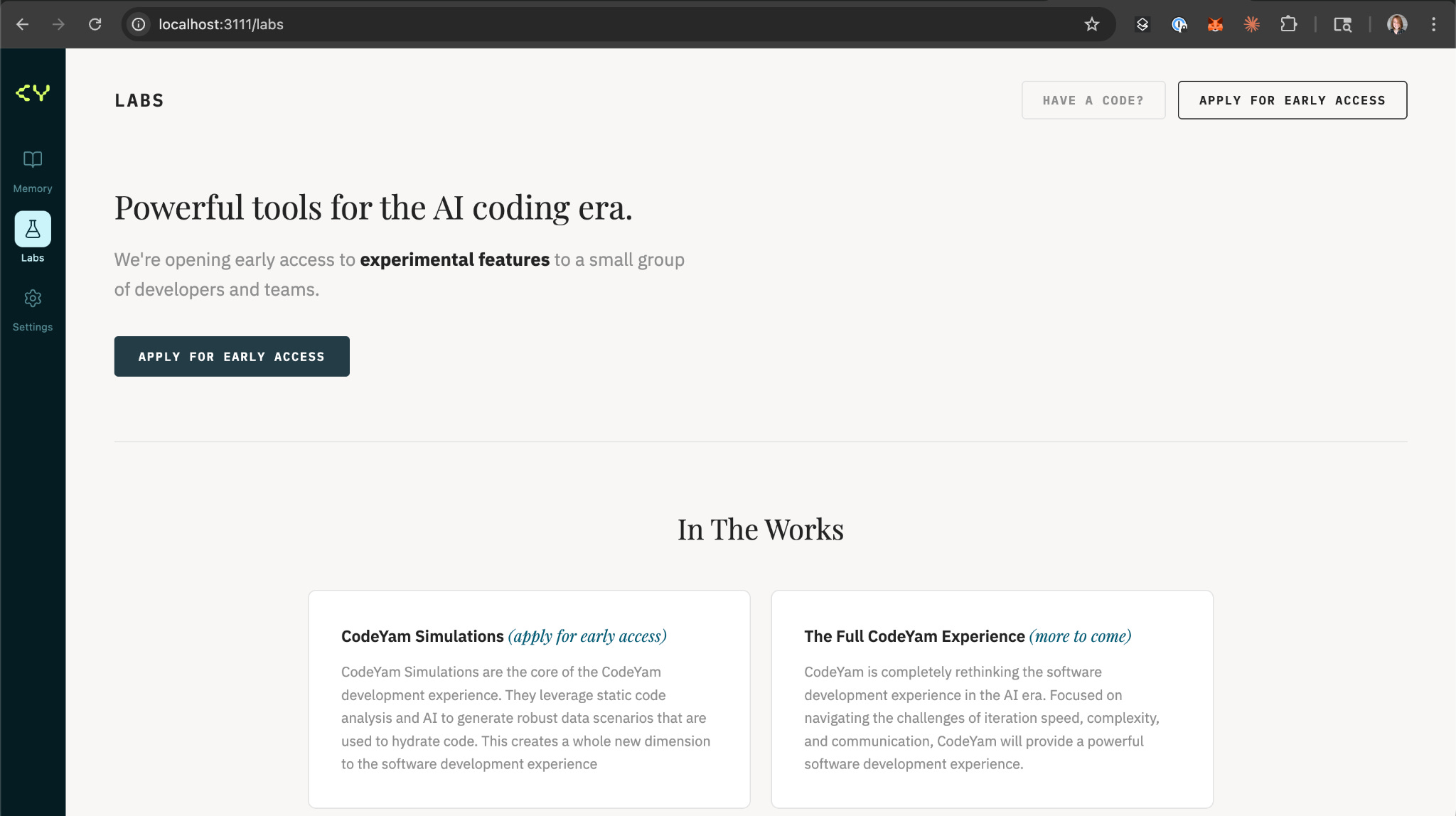
We did this by temporarily gating (for non-CodeYam team users) our more experimental R&D functionality and shipping our CodeYam CLI tool with the CodeYam Memory feature that external users could try front and center.
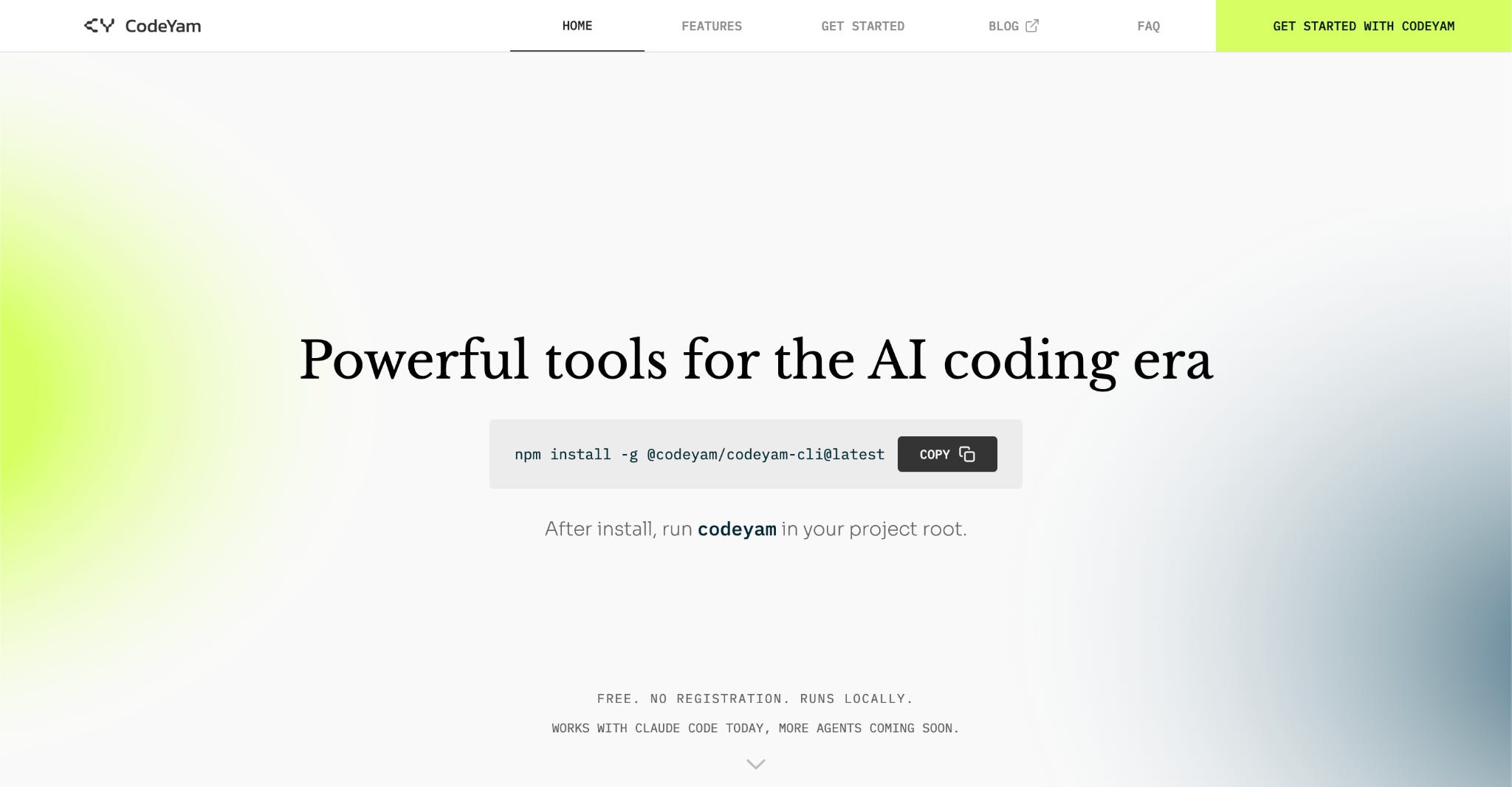
The tool can be installed in any terminal where you’re running Claude Code using an npm package and one-line installation instructions.
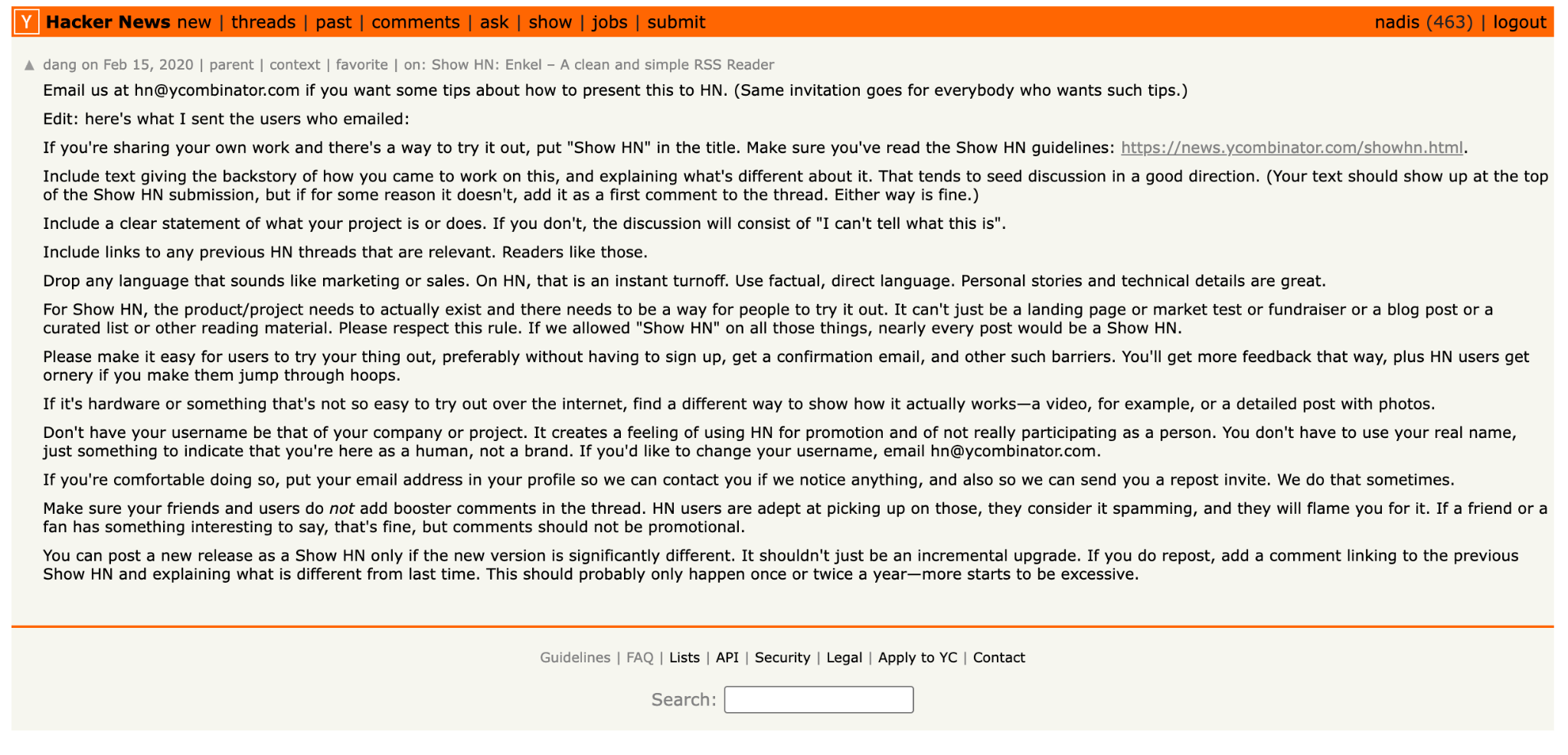
We wanted to make it as easy as possible for people to try CodeYam Memory, so following Show HN tips we made it free, local, and usable without sign-up.
We launched last week on Hacker News, and then this week on Product Hunt. I’ll share my raw observations and takeaways.
Although I’ve been on both Hacker News and Product Hunt for over a decade as a user, this was my first time launching anything as a builder or maker.
Since both were first launches for me, these learnings should be taken with a grain of salt.
Show Hacker News: The Launch that Failed
How We Prepared to Launch on Show HN
For our Show HN launch, our first public launch beyond sharing CodeYam with a small number of friends to test, we went in with a simple goal: make it as easy as possible for folks to try CodeYam Memory and for us to get feedback.
We tried to follow the Show HN tips and guidelines as closely as possible.
We redesigned and relaunched our website to emphasize how easy it is to get started with CodeYam CLI & Memory for Claude Code, and that the tool is free, local, and requires no sign-up.
We also shipped a launch blog post explaining why we built the tool and how to get started. We recorded two demo videos: one showing CodeYam Memory being used on our own project, and another showing it being used on a third-party open source project, Plane.
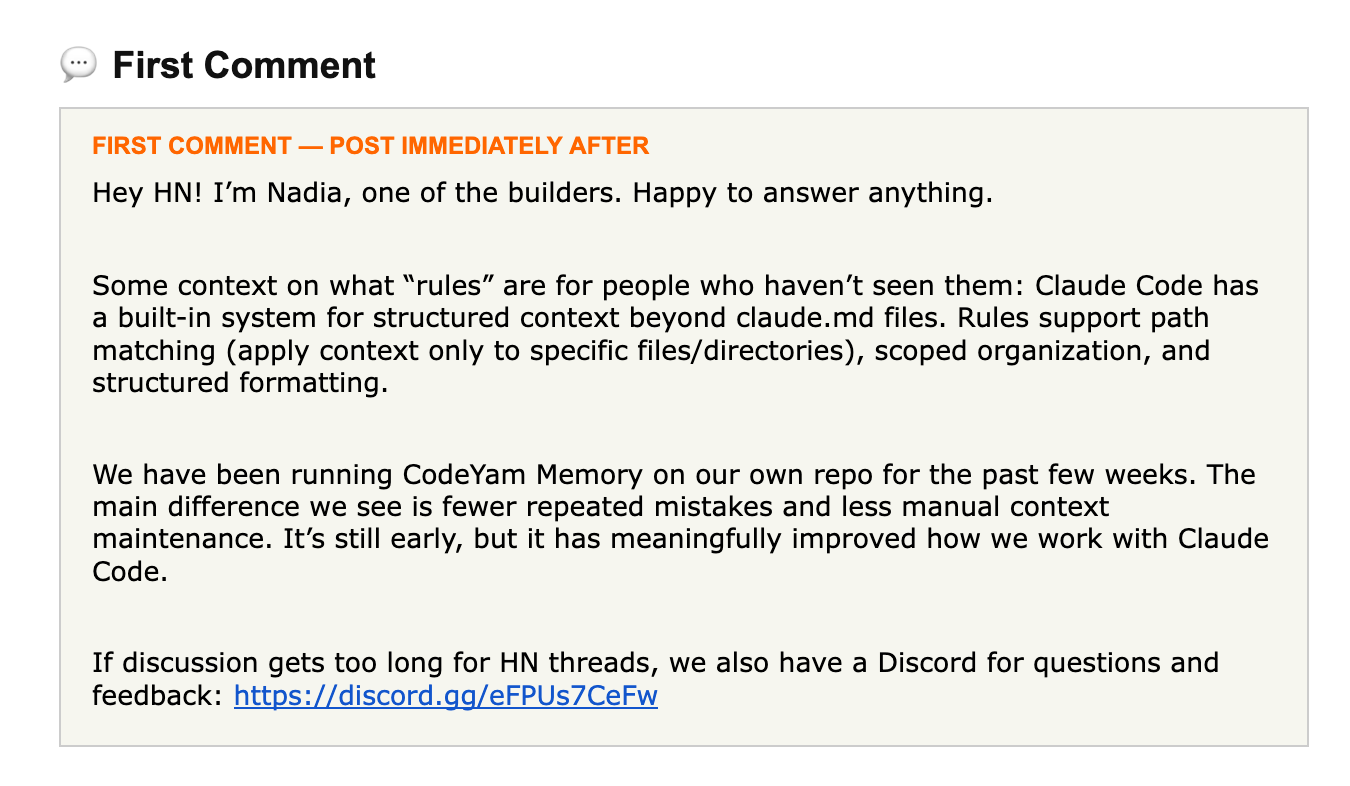
We drafted our Show HN post in advance along with my first comment as a maker. I also asked Anthropic’s Claude AI to analyze past launches to help aim for the right style and length, and repeatedly checked the Show HN guidelines and tips.
I even asked Claude Cowork when the ideal launch time might be and tried to follow the suggestions: mid-week and as early in the morning as possible. I’m not sure the recommendation was actually accurate, but I figured it didn’t hurt to try to follow it.
Show HN: The Launch That Was Invisible
I submitted our Show HN early in the morning last week (in my local Mountain Time). Almost immediately, despite waking up early, there was an avalanche of other Show HN launches. Our post was quickly pushed down the page – it felt like in seconds.
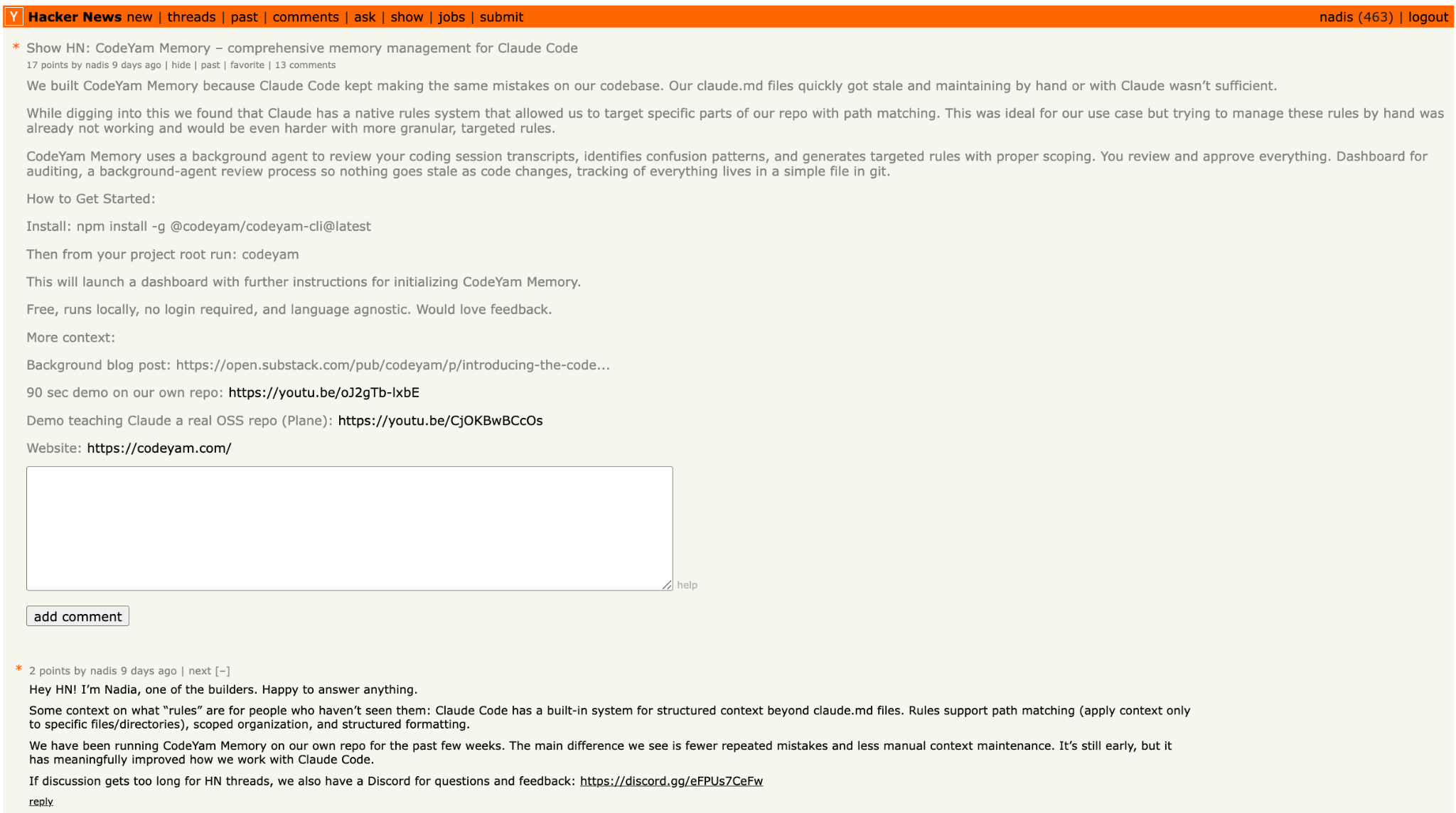
The first external comment was from a random HN user asking about my name, not asking questions or sharing feedback about our product.

In a move of desperation to at least give our launch a chance to be seen by anyone who might try what we built and find it useful or at least share feedback, we emailed friends and our investors and asked them to look for our launch and, if they had something meaningful to say, engage in the comments. Not that Hacker News strongly discourages this, in contrast to Product Hunt which encourages you to amplify your launch.
We had also been advised that sharing a direct link to a launch on HN could lead to throttling. So instead we asked people to find the post themselves from the main HN site or, as became increasingly necessary, search for “codeyam” and locate the most recent post.
Ultimately, none of this mattered.
The launch was visible on shownew on Hacker News, the page where you can browse the newest Show HN posts, and we got some upvotes and engagement from friends. But we never made it onto the main “Show” tab of Hacker News, let alone the front page.
What was interesting is that there were stale posts on Show HN with far less engagement than we had. We confirmed we weren’t shadowbanned or flagged, but I suspect heavy throttling by the HN team in terms of what actually makes it to the Show HN main page.
The Show HN rules state:
“Every Show HN appears on shownew. Once it clears a small points threshold, it will appear on the show page in the top bar.” In our experience, this wasn’t true.
It almost seemed like points didn’t matter, or that some points invisibly counted more than others. My leading theories are that votes from users with high karma carry more weight and that Show HN is more heavily moderated or curated than the rules suggest.
While I appreciate the HN team trying to prevent visibility from being gamed, it also feels like it has become extremely difficult for a launch to gain any visibility without getting very lucky. The alternative would be gaming the system, which we neither know how to do nor are particularly interested in doing.
This week, as an experiment, we had a different team member post a Show HN at a significantly earlier time, early morning Eastern Time. Same result. One external user commented, but it was a new HN account, and we never made the Show page or the front page.
Product Hunt: Surprise Overnight Success
After our failed Show HN launch, we were not feeling optimistic about the chances of getting visibility through popular launch sites. Still, we had a free product people could use, and it felt worth trying to launch it on Product Hunt as well.
Our small team had already moved on to our next product and engineering priorities, so I made a deal with my co-founder: I’d handle the Product Hunt launch mostly myself so it wouldn’t distract him or our team, and then report back with learnings.
I’ve been on Product Hunt for a long time (joined the site in July 2015) and introduced myself on the Product Hunt forum a couple of weeks ago, but had never launched as a “maker.”
Luckily, Product Hunt has a pretty robust launch guide. We were also able to update and repurpose some of the materials we created for the Show HN launch and adapt them for Product Hunt.
One major difference from Hacker News is that Product Hunt allows much less text description and relies far more on visuals like screenshots, a demo video, and links to your site and socials. There’s also the option to create an “interactive demo” which I briefly looked into but didn’t pursue.
I put together our Product Hunt launch and scheduled it for the next day.
When you schedule a launch on Product Hunt, it goes live at 12:01 AM Pacific Time, which gives you the biggest window to accumulate votes for that day. I went to bed planning to wake up early, though not early enough to see the launch go live at 1:01 AM Mountain Time.
Luckily, my co-founder is on Eastern Time. While I was sleeping, our launch organically picked up nearly 80 upvotes and he was able to respond to a couple of early comments.
When I woke up a few hours later, I realized we had a chance to be among the top launches of the day. This surprised me, especially since the very top launches were from startups and companies with large existing followings, e.g. Google and OpenAI both launched products that day.
Given our surprise early organic results, it felt worthwhile to keep an eye on things, so I prioritized responding to comments and questions. I also had a bit of an existing following on Product Hunt (around 200 followers), so it’s possible some friends saw our launch early on.
When I first checked, we were around #17 or #18. I realized we could move up fairly easily since only a handful votes separated the launches between #10 and #20.
Product Hunt allows and even encourages you to promote your launch, so I shared it on socials (my personal socials and our startup CodeYam’s pages) and sent a follow up email to friends and investors. I also shared the launch in a few WhatsApp and Slack communities I’m part of that allow this kind of content and have other founders who might empathize with our competitive launch day.
We eventually peaked at #13 for the day, with just a couple votes separating us from #12.
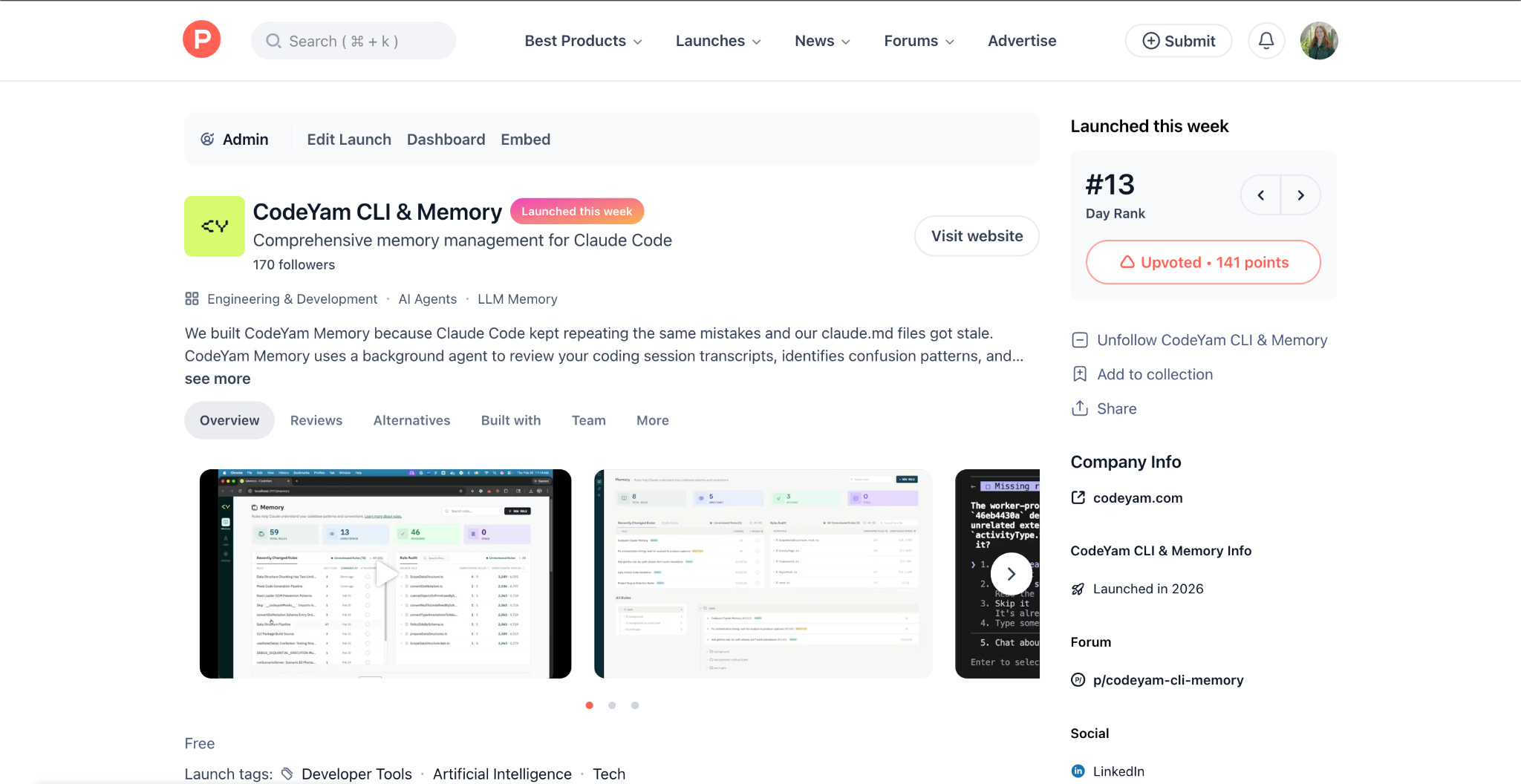
I also heard from several people that their upvotes or comments seemed to be throttled by Product Hunt. One founder friend told me they tried to comment but it didn’t go through; another said they upvoted and commented, but it never appeared. Still, at least some of the votes and comments came through.
My suspicion, though I can’t confirm it, is that Product Hunt weighs things like comment quality, account age, or account credibility when deciding what counts.
One thing Product Hunt encourages is getting verified. I had previously applied (and linked certain social accounts like LinkedIn), but only realized on launch day that my verification was still “pending.” It was approved later the same day, but not sure that it had any impact (seems unlikely).
Some of our friends and supporters are newer to Product Hunt (at least a couple amazing folks messaged me to tell me they joined so they could support our launch), so I suspect their impact, while still amazing and helpful, was limited. That said, these folks can now much more easily support future new product launches for us on Product Hunt, which could be impactful.
We also continued to get votes two days after the launch, which is nice but didn’t help our ranking by the end of launch day (we now have more votes than the company that finished #12, one spot above us for instance).
One thing I didn’t do, but noticed others did (including the team that was #1 the next day, which was an especially busy day on Product Hunt due to the promise of a Y Combinator interview for lucky founders), was to reach out to other PH Makers or Hunters in advance to ask for support.
Almost all of the #1 launches seemed to do this and had veteran hunters backing them, including self-proclaimed “#1 hunter” Chris Messina.
Unlike Show HN, when we launched on Product Hunt I received a lot of LinkedIn messages offering to sell upvotes. This is something Product Hunt does not allow, and something I have no interest in doing.
Unlike Show HN, our launch was featured on Product Hunt. I’m not entirely sure why, but I suspect the early organic traction helped.

Even though I tried to rally support (thanks, mom and dad) for a late surge, it seemed every other maker who launched that day was doing the same.
We finished the day at #13. I would have loved to break into the top 10 launches (which are featured in the next day’s Product Hunt newsletter), but honestly I’m quite pleased with the result.
Post-Launch Learnings
Overall, I’m glad we experimented with building in public and launched on both Show HN and Product Hunt. Despite our initial disappointment with Show HN, we had a good showing on Product Hunt.
Timing matters a lot, and there’s clearly an element of luck in when you launch. Community support matters too, but support from more established members seems to matter even more.
In hindsight, we might have done more to track results. We strongly followed the tip of making it as easy as possible for people to try the product and give feedback, but that also makes it harder to tell how many people actually tried it. Right now we’re mostly looking at lagging indicators like npm installs, feedback messages, and people joining our waitlist or Discord.
I’d like to have a simple way to know with more certainty when people install and use the product, although what we did felt sufficient for a lightweight launch of a small tool.
We’ll likely continue launching future products on both platforms. You’re welcome to follow CodeYam and/or myself on Product Hunt and of course look for anything CodeYam on HN or elsewhere.
The goal of this post isn’t to plug our launches but to share what I personally learned from the experience. That said, I’d be remiss not to mention that if you’re building software with Claude Code, you’re welcome to try CodeYam CLI & Memory. Feel free to share feedback here or in our Discord.
If this kind of write-up is useful, I’m happy to keep sharing what we learn.
Just let me know.
Always love reading about your journey!
A couple of additional reflections based on comments / feedback on this post.
1. What (if anything) would we do differently?
This is a tough question, because I don’t think there’s a definitive playbook that guarantees a great organic launch.
On reflection, I’m not sure we’d change much. If anything, we might try to launch sooner; though in reality we pushed pretty hard to get to Show HN as quickly as we could with a product we actually believed in. Shipping earlier is always tempting in hindsight, but I’m not convinced it would have meaningfully changed the outcome for the better.
2. Why didn’t you use paid agencies for Product Hunt?
There does seem to be a bit of a pay-to-play dynamic if you’re aiming for the very top spots on Product Hunt, especially if you’re not already a large or well-known company.
I received a lot of inbound messages from people offering to promote our launch to “real people,” but that didn’t feel aligned with our goals and honestly felt like a poor use of time and money. I basically just ignored all of those emails and LinkedIn messages.
What we really wanted to test was whether the product itself resonated and to get genuine feedback from people discovering it organically and not to optimize for ranking for its own sake.
We may have sacrificed a higher ranking by doing it ourselves, but for our goals and our team it still felt like the right approach.