

Recently, I’ve been reflecting on my own superpowers, and one of them is networking.
It’s funny because the word “networking” immediately gets followed by “ugh” in my head. I picture transactional business people frantically shilling their pitch, furiously collecting LinkedIn connections and business cards. That’s not what I mean by networking.
What is “networking” anyways?
Out of curiosity, I looked up the definition of networking:
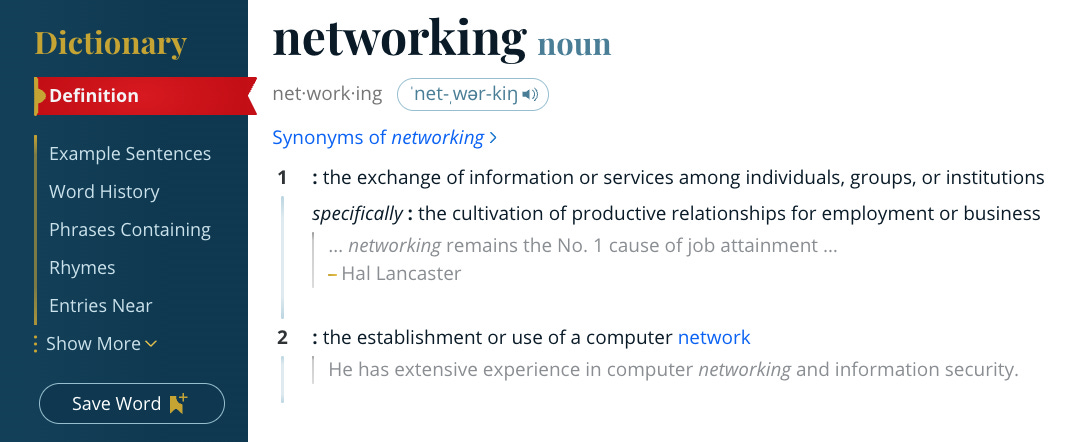
The idea of networking as connection (like a computer network) resonates far more for me than networking as transaction. “Cultivation” resonates as well.
My ability to network doesn’t come from loving networking or having some innate natural affinity for it. It comes from practice, experimentation, and learning over time.
Below are a few things that have worked well for me. Take them with a grain of salt. What works for me may not work for you.
More than any specific tip or trick, I think experimentation, and the willingness to occasionally feel awkward, silly, or vulnerable, will take you the farthest.
Networking Tips for Humans
Learn theory from experts, then experiment yourself.
Some of the books and articles I’ve found most valuable on networking come from people who are/were true experts in their domain and era.
While I wouldn’t copy-paste someone else’s framework wholesale, and there are definitely approaches I’ve actively rejected, I still think there’s enormous value in learning how others have approached the challenge of building relationships and communities.
Theory can give you language, mental models, and inspiration. But ultimately, networking is deeply personal. What works for one person may feel unnatural or ineffective for another.
The important part is experimentation: trying things, observing what feels authentic, noticing what creates genuine connection, and gradually developing your own style over time.
Some books I’ve found valuable:
Never Split the Difference: Negotiating as If Your Life Depended on It by Chris Voss
The Art of Learning: An Inner Journey to Optimal Performance by Josh Waitzkin
How to Win Friends and Influence People by Dale Carnegie
Get Together by Bailey Richardson, Kevin Huynh & Kai Elmer Sotto
The Art of Gathering by Priya Parker
Daring Greatly by Brené Brown
Connect - Building Exceptional Relationships by Carole Robin & David Bradford
Quiet: The Power of Introverts in a World That Can’t Stop Talking by Susan Cain
UX Research blog post series by Michael Margolis
That said, no amount of theory or reading replaces actually interacting with other humans. When you learn something that resonates, go practice it.
One thing that’s helped me: when experimenting with a new approach, try it in a way that feels almost exaggerated.
Most likely, you’re coming across far less strongly than you think you are, so it helps to really push yourself when testing something new. If you overdo it, it will usually become obvious pretty quickly.
The important thing is committing to experimentation. You can always calibrate and tone things down later.
Humans have feelings. Embrace that in interactions.
Humans are not robots, and part of our magic, and chaos, is that we have feelings. Rather than fighting that, lean into empathy and, to the extent you can, genuine curiosity about how other people feel.
For example, when I’m nervous meeting someone new, I try to channel that nervous energy into curiosity. I want to get to know them. I hope the interaction goes well. I want to like them.
Often, I express that through an authentic compliment followed by a question.
Made-up example: I’m getting my morning coffee and notice the barista wearing a unique necklace. Things are slow, so it feels like an okay moment to try striking up a conversation.
“Hi! I love your silver necklace. What’s the story behind it?”
More often than not, the person will respond warmly, and it leads to a brief but meaningful interaction. Depending on how they respond, I might ask more questions if they seem engaged, or simply let the interaction end naturally.
One important caveat: the compliment must be authentic, and you actually have to listen to the response.
People can usually sense when you’re being fake, distracted, or just waiting for your turn to talk. Their response often mirrors the energy you bring into the interaction.
So: be authentically positive and curious.
A simple experiment to try:
“Hi! [Give authentic compliment]. [Ask question]. [Listen].”
Ask unusual, open-ended questions.
Rather than opening with “How are you?”, which will often get a one-word “good” in response, try asking more unusual, open-ended questions.
Even a small tweak like:
“What’s been the highlight of your day so far?”
often leads to a much more interesting conversation.
In general, I tend to avoid yes/no questions in favor of open-ended ones. Ideally, the question requires a little thought, but not too much, especially early in a conversation, and feels interesting or enjoyable for the other person to answer.
For example, at a conference, instead of asking:
“Have you been enjoying the event?”
you could ask:
“What’s been the most interesting session or conversation you’ve had so far?”
or:
“What’s one insight from today that’s sticking with you?”
Questions like these tend to create more memorable and engaging conversations. They also make it easier to build on the response naturally and share your own thoughts in return.
Listen. Don’t interrupt.
Active listening is an incredibly underappreciated skill, and it’s foundational to building meaningful interactions and relationships, even brief ones.
When someone else is speaking, don’t spend the whole time planning what you’re going to say next. Actually listen to what they’re saying.
In most cases, don’t interrupt.
One rare exception: if someone is rambling or you’re genuinely struggling to follow, it can be okay to briefly interject and reflect back what you heard to make sure you understood correctly. But this should be the exception, not the default.
Personally, I find it frustrating when people interrupt to insert their own thoughts. At the same time, I’ve noticed this is often driven by nervousness. People are especially likely to do it in new social situations or group settings where they want to make an impression.
Try not to be that person.
Instead, put your energy into listening well.
Funnily enough, I’ve found that when I make people feel genuinely heard, they’re usually much more interested in hearing what I have to say in return.
Follow up, repeatedly and thoughtfully.
I love connecting people in my network when I think they might genuinely enjoy knowing each other or be able to help each other, like introducing a VC to a founder building in their vertical.
What I’ve found, though, is that it’s surprisingly rare to receive meaningful feedback, or even a simple thank you, after making an introduction.
When someone does follow up thoughtfully, it means a lot. It also makes me much more likely to want to keep supporting them and connecting them with people in my network.
Hearing how a conversation went between two people I introduced is invaluable feedback, whether the connection was fruitful or didn’t quite work out for whatever reason.
So when someone connects you with another person, share your gratitude. And consider closing the loop with thoughtful feedback afterward.
A simple follow-up can go a long way:
“Thank you again for making the intro. We had a great conversation about X, and I especially appreciated Y. I’m grateful you thought to connect us.”
Don’t ghost people you know.
With more messaging platforms than ever before, it’s easy to lose track of follow-ups or decide not to respond when something doesn’t feel especially urgent or important. Honestly, it’s practically impossible to keep up with every message, and I definitely understand the occasional urge to unsubscribe from everything and disappear into the woods.
That said: don’t ghost people you know.
Personally, I have different expectations and response-time “SLAs” for different kinds of relationships, from close friends to professional acquaintances. But in general, I do my best to respond to people I know, even if it takes me a while.
And when I inevitably realize I forgot to reply to someone, I apologize.
No elaborate excuses. No defensiveness. Just taking responsibility and saying, plainly:
“I am sorry.”
I think people underestimate how meaningful simple accountability can be.
Friends are not CRMs. Be thoughtful with intro asks.
When people ask me for introductions, I often genuinely want to help.
Help me help you by making intro requests that are thoughtful, specific, and easy to act on.
The best intro asks are usually one-off requests with enough context for me to understand:
who you want to meet,
why you want to meet them,
and why the connection makes sense.
If you don’t have a specific person in mind, give as much color as possible.
For example:
“Do you happen to know anyone in X role or Y industry? I’m exploring Z and would love to learn more.”
That’s much easier to help with than a vague:
“Do you know anyone in AI?”
If you do have a specific person you’d like an introduction to, ideally send a short blurb I can forward directly. Make it easy for the connector to help you.
One specific note for founders: please don’t ask someone to introduce you to “all their investors.”
It comes across as lazy and self-centered, even if that’s not your intent.
Instead, do a little homework. Look at who their investors are and ask for introductions to the one or two that seem most relevant. Or ask the founder if they have suggestions — but provide enough context for them to make a thoughtful recommendation.
One resource I really like on this topic is Elad Gil’s essay, How To Ask For An Introduction.
When making introductions, always get double opt-in.
Elad Gil has another great essay on this topic: Ask Before You Intro.
Before facilitating an introduction, make sure both people actually want to be connected.
This sounds obvious, but in practice it can take real effort. Thoughtful introductions often require context gathering, individual outreach, and a bit of coordination. But doing this dramatically increases the chances that the connection will actually be valuable for both people.
Beyond getting opt-in, it’s also important to think about how the introduction should happen.
Not everyone prefers the same communication channels. Some people live in email. Others respond much faster on WhatsApp, Signal, Telegram, text, or LinkedIn.
A small but underrated detail of making good introductions is understanding how each person prefers to communicate, and choosing a channel that works well for both of them.
Low pressure, low expectations, high hope.
I often notice that when people really want a meeting or interaction to go well, they put so much pressure on themselves that it actually sabotages the interaction.
Instead of entering conversations full of nerves and expectations, try letting go of the pressure.
Have hope. Don’t cling to expectations.
It’s great to hope for the best — otherwise, why spend your time and energy? But I try not to overindex on a specific outcome or pressure myself into “achieving” something from the interaction.
There’s so much outside of your control. Even connections that seem perfect on paper sometimes just aren’t the right fit, or aren’t the right fit right now.
And if an interaction seems to be going poorly, don’t assume you know why.
For example, your interviewer may seem distracted or frustrated not because you’re bombing the interview, but because their team is dealing with a fire drill or their kid is sick.
Most people are carrying around invisible context that has nothing to do with you.
So my approach is:
Low pressure. Low expectations. High hope.
If you feel confident, be confident (not braggadocious).
You’re not always going to feel confident while networking, and that’s completely normal.
But if you do feel particularly good, energized, or confident, you can channel that energy in a way that uplifts the people around you and leaves the interaction feeling lighter and more positive for everyone involved.
Confidence and bragging are not the same thing.
One silly example: there’s a common joke about people who went to Harvard University — either they’ll tell you within the first two sentences of meeting them, or they’ll awkwardly say something like:
“I went to school in Boston.”
Honestly, both approaches feel suboptimal to me.
If someone asks where you went to school and the answer is Harvard, just say Harvard plainly and confidently. No need to downplay it, but also no need to force it into the conversation unprompted.
Don’t open interactions with:
“When I was at Harvard…”
Let people discover your accomplishments naturally, as they become relevant or when they ask.
Being confident doesn’t mean leading with your résumé or listing achievements. It means being comfortable with who you are without needing to perform it constantly.
Lead with your humanity, not your accomplishments.
Even in contexts like job interviews, I think frameworks like the STAR method work best when they ground achievements in human context, stories, emotions, and lessons learned. That’s what tends to make people memorable and engaging.
Be appropriately vulnerable to set the tone of interactions.
I’ve found that being appropriately vulnerable can help other people feel more connected and often encourages them to mirror that openness and candor in return.
By vulnerability, I mean sharing authentically and including thoughts, feelings, or experiences that feel slightly uncomfortable or expose a more human side of yourself.
The key word here is appropriately.
The right amount of vulnerability depends on the situation and the relationship. Don’t trauma dump on the CEO you just met at a conference.
One thing that can help with calibration is reflecting after interactions:
How much did you share versus ask questions and listen?
When you did share, did it feel authentic and appropriately vulnerable?
Did your contribution deepen the interaction, or distract from it?
Personally, I try to maintain a high ratio of listening and question-asking relative to sharing. But when I do share, I want it to feel meaningful.
Sometimes vulnerability is lighthearted, like making a silly joke. More often, it looks like sharing something that puts you a little “out there.”
For example:
“Great weather we’re having.”
is common ground, but isn’t vulnerable or personal.
While:
“I loved your talk because XYZ really resonated with me personally after an experience I had…”
is more personal and vulnerable.
And something like:
“I still get butterflies before public speaking, but I’m glad the demo went well today. How did you feel before your talk?”
is even more vulnerable, while also inviting connection in return.
Mirroring makes a difference.
One communication technique I’ve found surprisingly powerful comes from Chris Voss’s book Never Split the Difference: mirroring.
Mirroring means reflecting back specific language or phrasing someone else used.
For example, if someone says:
“I love rock climbing, especially bouldering in Colorado.”
you might respond with:
“What do you love about bouldering in Colorado?”
or even simply:
“Bouldering in Colorado?”
By reusing some of the exact words the other person used, you signal that you actually heard them.
The key is pairing the mirror with genuine curiosity, a follow-up question, or a new thought so the conversation continues moving forward rather than feeling robotic or repetitive.
I’ve found mirroring useful in both spoken and written communication. Even in emails or text conversations, subtly reflecting someone’s wording or framing can help them feel understood and acknowledged.
It’s a small thing, but small things often make a big difference in human interactions.
It’s okay to walk away from an interaction.
Not every interaction is going to feel amazing, and that’s okay.
I think it’s good to push yourself to engage even when it feels awkward or uncomfortable. But that’s different from situations that feel genuinely draining, unproductive, or bad. In those cases, it’s okay to end the conversation and walk away.
At conferences or events, I’ll often use simple exits like:
grabbing more water or coffee,
heading to another session,
going to the restroom,
or needing to meet someone.
You don’t need a dramatic reason to leave a conversation.
And in virtual meetings, sometimes directness works surprisingly well. You can simply say something like:
“Hey, I’m getting the sense this may not be the best fit. Would it make sense to end early?”
Counterintuitively, offering to end a conversation can sometimes shift the energy entirely. The other person may suddenly become more engaged, present, or authentic once the pressure is removed.
And if not, that’s okay too.
Not every connection is meant to become a deep relationship, and part of networking well is recognizing when to gracefully move on.
Finally, have fun and experiment!
At the end of the day, networking is just humans connecting with other humans.
So try to have fun with it.
Celebrate the fact that you get to experiment, play, and learn through meeting other people and hearing their stories, understanding how they see the world, and building relationships over time.
None of us fully know what we’re doing. We’re all just figuring it out as we go.
These tips and suggestions are far from exhaustive, but I hope they’re helpful.