

The Olympic sport of fencing and the elusive pull-up
The summer after my freshman year of college, I joined my brother and a group of elite fencers training at the Olympic Training Center in Colorado Springs. Beyond fencing, we also regularly lifted weights and did track workouts to improve our speed, endurance, strength, and conditioning.
When I arrived, I was already in excellent fencing shape, but I could not do an unassisted pull-up (I used bands). That summer, I became the fittest and strongest I’d ever been. Yet even though I progressed from a thick assistance band all the way to the thinnest, I still could not do a pull-up without assistance. After several weeks of hard training, I left closer than ever to my goal of doing a bodyweight pull-up…but still unable to do one.
I assumed, incorrectly, that for whatever reason my body was just incapable of doing an unassisted pull-up. I have long, Gumby-like arms and hypermobility (my joints flex beyond the normal range), so I thought perhaps it was an anatomical constraint or something to that effect. I gave up on doing a pull-up and never thought about it again.
Bouldering and an unexpected breakthrough
That is, until I moved to Denver, Colorado, in 2023. There, I picked up climbing, especially bouldering. To climb, you not only need to be flexible and strong, but you also need to be able to pull yourself up.
You pull yourself up to “top out” on certain structures at the bouldering gym and often pull in addition to using your legs. Some climbers even practice “campusing,” meaning climbing without touching the wall with their feet or legs (just arms, sort of like the monkey bars you used as a kid, which I also never really could do well).
As I got into climbing, I took classes at my local gym (shoutout to the coaches and team at Movement RiNo). There, I learned about climbing-specific conditioning to build finger strength and train specific movements. To my surprise, despite not having any pull-up goals as a climber, I eventually found that I could do not only one but several bodyweight pull-ups. I was shocked!
Here was a goal I assumed I’d never achieve. Yet in pursuit of a different goal, I managed to achieve it and surpass all my previous attempts.


This led me to a surprising insight:
Sometimes the best way to make progress toward a goal is to focus on another, seemingly unrelated goal.
Bonus if it’s an ambitious or complex goal that requires progress on several fronts.
I’ve started thinking of this as orthogonal goal-setting: approaching progress from a different direction instead of tackling a goal head-on.
Running: distance goals and faster miles
This realization recently came up again in my running training.
Earlier this summer, I was trying to decide what running-related goals I might want to set for the rest of 2026.
I listened to some podcasts, notably Jonathan Levitt’s interview with Rachel Entrekin on his podcast “For the Long Run.” I decided I’d choose between speed- or distance-related goals and, after asking the internet, landed on distance as my primary focus.
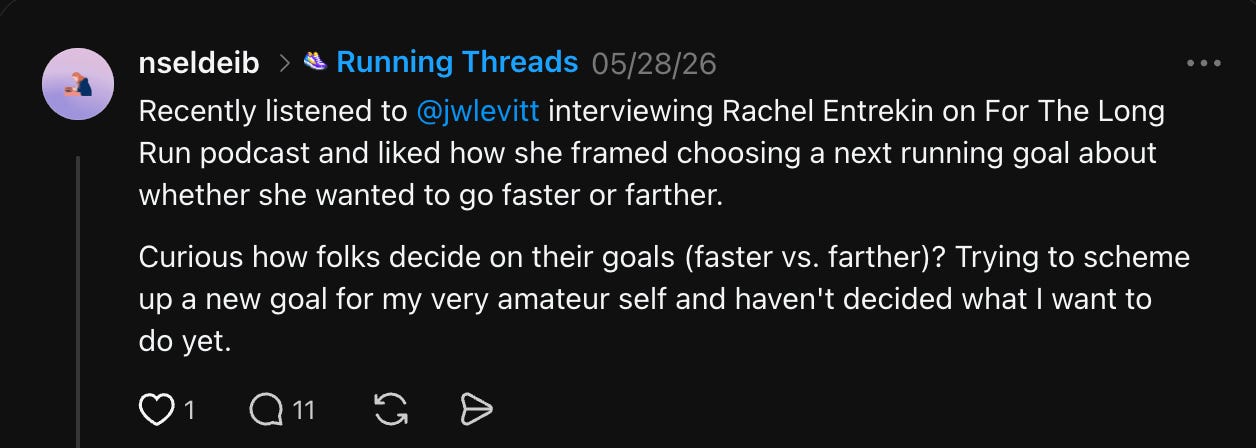
This was before starting Runtoberfest, which combines running farther with racing more often in October than ever before. Running farther seemed like the right goal.
As I got into running in NYC after moving, I started taking NYRR Group Training classes to mix up my workouts and motivate me to do more tempo work as I trained to run farther.
Yet despite choosing to focus on distance and endurance first, I noticed something wild. My miles also got faster!
I’ve set accidental personal bests across a range of distances from my shortest to my longest runs. I recently crushed my best recorded 5K time in a training run (I only started tracking runs within the past 10 years). While it was a time trial, it was also on Central Park’s hills, which makes me suspect I could go faster.
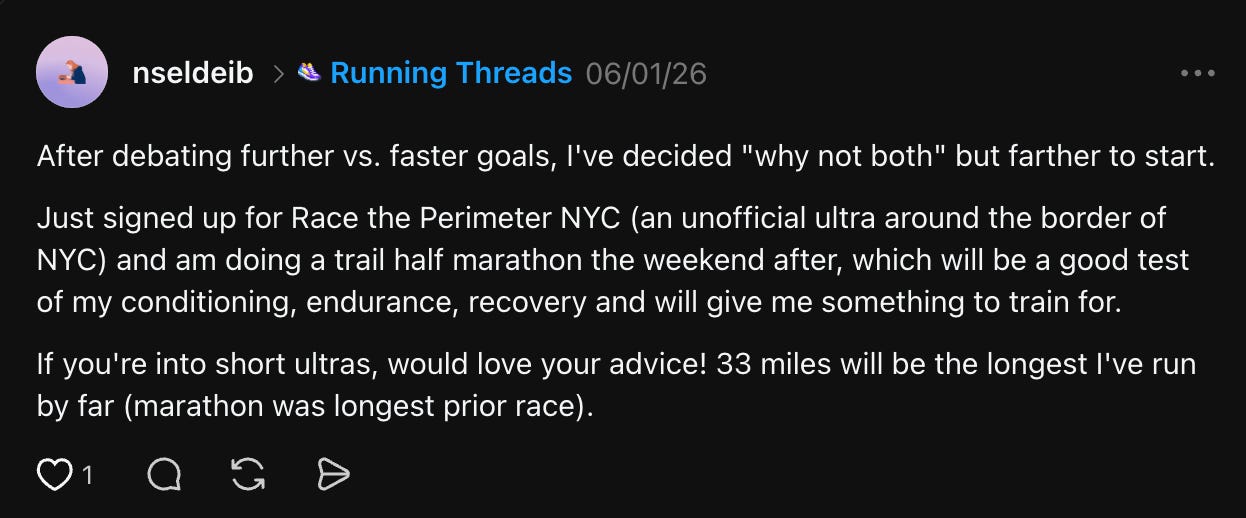
I’m also well on my way to my endurance and distance goals, having already completed Race the Perimeter and the Paine to Pain Trail Half Marathon earlier this month, with two more races to go.
In my first – and thus fastest – 50K+ race, I ran 31.72 miles in about 7 hours according to my watch, with many walking breaks (and some phone time to support a friend through a major life event!). More recently, I ran my fastest half marathon at last weekend’s trail race.
Since setting my distance and endurance goals this summer, I’ve gone both farther and faster. Knock on wood, I’ve also managed to stay healthy and injury-free throughout training and racing, which feels like a significant part of achieving radically ambitious goals in a sustainable way.
Applying the idea to work as a startup founder
While this is mostly a self-reflection focused on non-work goals, I’ve started to wonder whether the same principle of orthogonal goal-setting might apply to my work as a startup founder.
Rather than smashing myself against the same extremely hard-to-achieve goals, maybe I should consider setting orthogonal goals and measuring progress against those. I don’t yet have a concrete idea of how to apply this, but the thought has been lurking in my mind for a couple of weeks now.
Sometimes I feel like I’m running into a brick wall over and over as a startup founder, trying to break through and solve incredibly hard or complex problems.
My cofounder Jared Cosulich’s advice to practice “being water” often comes to mind here. He, and now we, are inspired by United States Air Force Colonel John Boyd’s OODA loop.
That advice, along with my experience with orthogonal goals, makes me want to pursue goals and progress more fluidly, relying less on pure force. As we keep moving, I bet we’ll be surprised at what we learn and achieve.


Applying the idea to AI agents as a software product builder
Additionally, in a somewhat wilder application, I wonder if this might affect how I manage AI agents. This is frequently on my mind as I use them in much of my work and increasingly teach my peers how to use AI in their work and personal projects.
In general, I’ve tried using clear, direct language to get agents to achieve a specific goal or purpose. I often recommend that folks treat an AI agent like a capable but new colleague. I usually aim for a Goldilocks amount of detail: not too vague or brief, but not so much that I’m writing a dissertation and can’t verify whether the outcome is what I intended or hoped for.
Now I wonder if orthogonal goal-setting might reveal better processes or results in certain cases, helping agents achieve outcomes I’d previously failed to guide them toward directly. I’m not sure, but I look forward to experimenting with orthogonal goals for AI agents, especially when building software.
For now, whenever I feel stuck, I want to remember that some of my biggest breakthroughs happened while I was working toward something else.